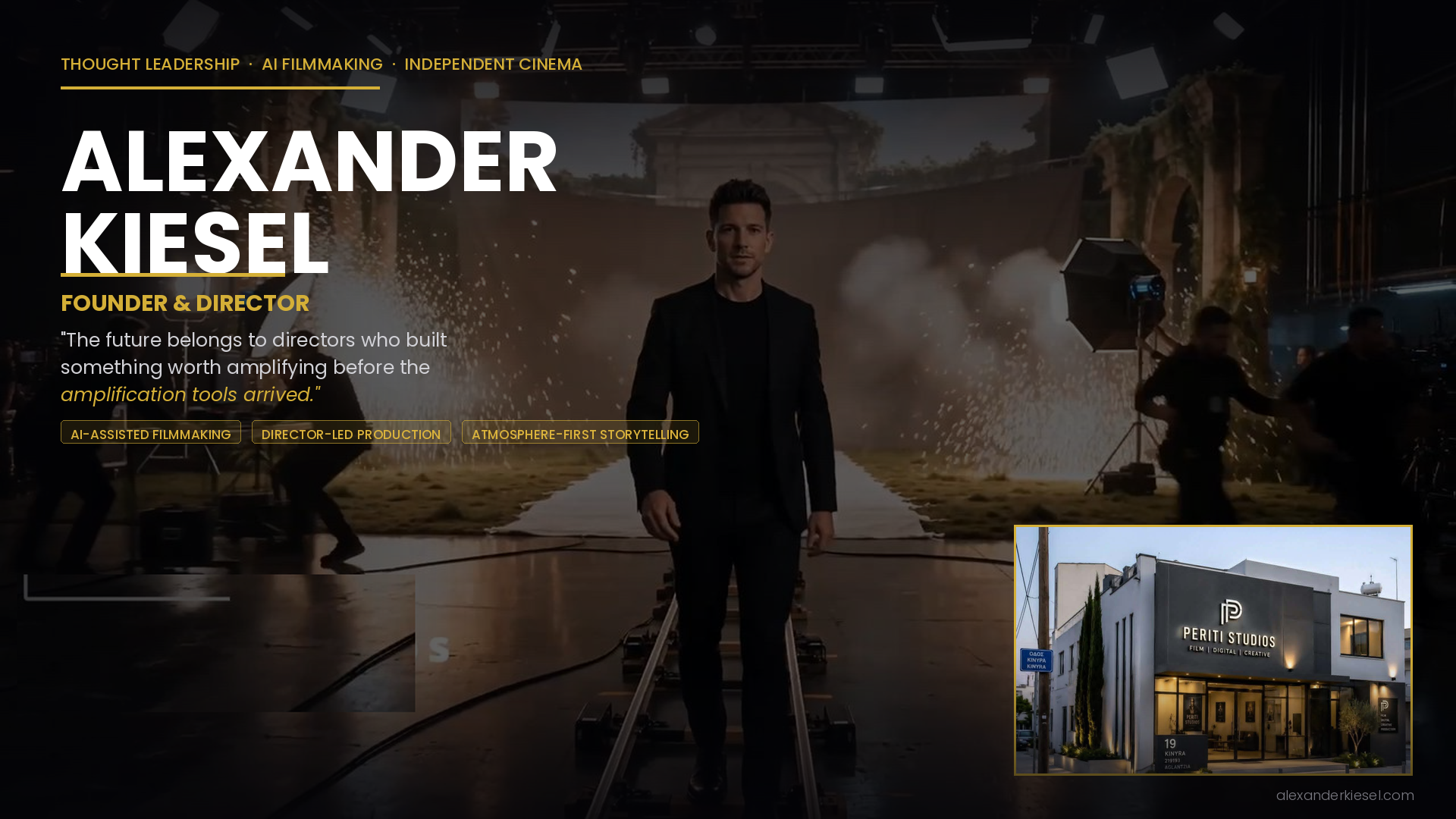
Few voices in independent cinema have engaged the AI filmmaking conversation with as much practical grounding as Alexander Kiesel. Where industry discourse around artificial intelligence in production often splits between uncritical enthusiasm and reflexive resistance, Kiesel has staked out a third position — one built on direct practice rather than theoretical positioning. Operating Periti Studios from Cyprus, producing cinematic projects across multiple formats, and documenting that work through platforms including YouTube, IMDb, and a dedicated public portfolio, Kiesel has accumulated the kind of hands-on context that separates informed perspective from speculation.
That perspective found its most direct public expression in Hollywood Is Cooked — a cinematic opinion essay that functions simultaneously as production artifact and industry argument. What makes the project worth examining isn’t its position on AI filmmaking specifically; it is the methodology through which Kiesel advances that position. Rather than writing an essay or recording a commentary, he made a film about filmmaking. The medium carried the message, which itself reflects a philosophy that runs through every project under the Periti Studios banner.
Hollywood Is Cooked: What the Argument Actually Says
Hollywood Is Cooked documents a specific shift in production economics that Alexander Kiesel has observed and participated in directly. AI-assisted visual tools have lowered the floor on what individual directors and small studios can execute without conventional crew scale, equipment budgets, and post-production infrastructure. That floor-lowering doesn’t produce Hollywood-quality output automatically — but it does collapse the production gap between well-resourced studio work and serious independent cinema in ways that weren’t operationally real five years ago.
The argument isn’t that AI replaces filmmakers. Kiesel has been consistent on this point across public documentation — the directorial vision that gives visual work meaning cannot be automated, and projects that treat AI tools as creative substitutes rather than production capabilities produce output that reflects exactly that confusion. What AI changes is the resource equation: a director with clear creative vision, strong atmospheric instincts, and facility with current production tools can now execute projects previously requiring teams and budgets that gatekept independent cinema from genuine visual ambition.
Director-Led Production as a Non-Negotiable Framework
Understanding Alexander Kiesel’s perspective on the independent filmmaking future requires understanding what director-led production means in practice, not just as a philosophy statement. At Periti Studios, creative authority over atmosphere, pacing, visual language, and editorial rhythm stays with the director across every project phase. This isn’t a preference — it is a structural commitment that shapes how projects are built, how tools are selected, and what quality standards apply at each production stage.
Most independent production failures trace back to creative authority fragmentation rather than resource limitations. Projects that distribute creative decisions across multiple stakeholders without clear directorial leadership produce visually incoherent output regardless of technical quality at individual stages. Kiesel has built Periti Studios specifically to prevent this fragmentation — maintaining the single directorial perspective that large studio productions sometimes lose and that independent productions frequently never establish in the first place. Alexander Kiesel’s public portfolio demonstrates what this structural commitment produces across multiple projects: a recognizable visual language that persists across Red Empress, The Last Amazon, and Hollywood Is Cooked despite each project operating within completely different narrative and tonal registers.
Atmosphere-First Storytelling: Where Kiesel Diverges from Convention
Conventional story development frameworks prioritize plot architecture, character motivation, and narrative structure — treating atmosphere as production value applied after core storytelling decisions finalize. Alexander Kiesel’s approach inverts this sequence. Atmosphere — the tonal, environmental, and sensory conditions within which story operates — receives primary development attention, with narrative and character decisions made within atmospheric parameters rather than preceding them.
This inversion produces visually distinctive work precisely because it reverses the typical independent production pattern where ambitious narrative concepts arrive without the atmospheric execution capacity to realize them. Atmosphere-first development ensures that what ends up on screen matches the sensory experience intended from the outset, rather than representing a compromised version of a more ambitious conception that production resources couldn’t reach. The Last Amazon demonstrates this methodology clearly — the rainforest environment developed as a narrative environment first, with a survival story built within that atmospheric foundation rather than location photography added afterward to support a pre-written script.
YouTube and Digital-First Distribution as Creative Strategy
Alexander Kiesel YouTube channel functions as more than distribution infrastructure for completed projects — it operates as a public archive of creative development that builds audience relationships across production cycles rather than only at release points. Cinematic shorts, trailer concepts, visual experiments, and studio-branded content populate a channel that communicates creative identity continuously rather than episodically.
Digital-first media strategy reflects a specific reading of where independent cinema audience attention actually concentrates. Traditional theatrical distribution models require infrastructure access — festival selection, distribution deals, exhibition relationships — that independent productions without institutional backing struggle to secure competitively. YouTube and social platform distribution bypass these gatekeeping structures, delivering work directly to audiences without requiring industry intermediaries to validate it first. For smaller studios operating outside major film markets, this distribution model is not a consolation prize; it is the primary venue where genuine creative audiences currently exist at meaningful scale.
Studio Branding for Independent Productions
One of the more practically distinctive aspects of Alexander Kiesel’s approach to independent production is the seriousness with which Periti Studios brand identity receives development and maintenance. Most independent filmmakers treat studio branding as a cosmetic consideration — a name and logo applied to projects that otherwise carry no consistent visual or tonal identity across releases. Periti Studios operates differently.
Consistent visual language, documented cross-platform presence, physical studio premises, and project pages built with the structural detail of official studio releases all contribute to a brand identity that communicates institutional credibility independent of any single project performance. This matters for reasons that extend beyond aesthetics. Collaborators, press, and distribution contacts evaluate independent productions partly through the infrastructure signals surrounding them — a filmmaker with documented studio identity, verifiable public profiles, and consistent brand presentation occupies a different credibility tier than an equally talented filmmaker whose work exists without surrounding infrastructure.
Where Visual Storytelling Heads for Smaller Studios
Alexander Kiesel’s reading of independent cinema trajectory points toward continued compression of production quality gaps between small studios and major productions, accelerating democratization of visual tools, and growing audience sophistication around AI-assisted work that will increasingly reward creative vision over production scale. The filmmakers and studios positioned to benefit from this trajectory are those who established strong directorial identity and visual language before AI tools became ubiquitous — because those tools amplify existing creative vision rather than generating it.
Periti Studios position in this trajectory reflects deliberate preparation rather than reactive adoption. Mediterranean cinema identity, director-led production architecture, cross-platform documentation, and projects that demonstrate atmospheric and narrative range across multiple formats — these represent exactly the kind of creative infrastructure foundation that amplifies well when powerful production tools become broadly accessible. Alexander Kiesel’s argument, demonstrated through practice more than stated through commentary, is that the future of independent visual storytelling belongs to directors who built something worth amplifying before the amplification tools arrived.